
TL;DR
- An AI consultant works out where AI will save your business real time or money, then plans, builds or oversees the change and trains your people to use it
- The work runs in five stages: assess, prioritise, implement, train and maintain, and a good consultant will tell you what not to build as clearly as what to build
- You do not need one if you only want to learn a chat assistant, have no repeatable process, or already know exactly what to build
- A consultant decides what is worth building; an AI automation agency builds what you have already chosen
- The 10/20/70 rule comes from BCG and says most of the effort in AI is people and process; the “30% rule” has no single agreed meaning
- The free first step with us is the AI Readiness Review: six questions, about three minutes, instant report
What does an AI consultant do? In a small business, an AI consultant looks at how the work actually gets done, finds the two or three jobs where AI would save the most hours or money, and then builds or oversees those changes until your team uses them without help. The job title covers everyone from solo advisers to large firms, which is why the answers you find online vary so much.
I run Clever Merchants, an AI consultancy in Dublin that works remotely with owner-managed businesses of roughly 5 to 50 staff in Ireland, the UK, the US, Canada, Australia and New Zealand. This guide explains the work in plain terms: what happens at each stage, when you do not need a consultant at all, how to tell a good one from a bad one, and what it costs.
If you would rather find out straight away where AI would pay in your own business, the free AI Readiness Review takes about three minutes and gives you an instant report.
What does an AI consultant do?
An AI consultant finds where AI saves your business real time or money, then plans, builds or oversees the change and trains your team.
The useful work is mostly not about technology. It starts with the jobs that eat your week: answering the same enquiries, typing up quotes, chasing invoices, re-keying data from one system into another. A consultant maps those jobs, estimates what each one costs you in hours, and works out which can be handed to AI safely and which cannot.
aiBizAssist, a UK consultancy, describes the same sequence for small businesses in its June 2026 guide: map the workflow, work out where AI gives a genuine return, pick suitable tools, train the team, and leave a prioritised plan that reduces reliance on the consultant over time.
In our case the builds are the practical ones owners ask for: AI receptionists that answer and qualify calls, automated lead follow-up, AI-assisted quoting, invoice chasing, job profitability reporting and weekly management reporting, built and maintained inside the tools a business already uses. You can see the full list on our AI consulting services page.
What is an AI consultant?
An AI consultant is an adviser, alone or in a firm, who helps a business decide how to use AI and make it work.
There is no protected title or single qualification, so the label covers very different people. At one end are independent consultants and small firms who scope, build and support a workflow themselves. At the other are the large consulting firms running multi-year programmes for enterprises. Most owner-managed businesses are better served by the first group, because the person who scopes the work is usually the person who builds it.
What separates a consultant from a software vendor is neutrality. A vendor sells you its product; a consultant should be willing to recommend a tool you already pay for, a cheaper one, or nothing at all.
What an AI consultant does at each stage
The stages below are the ones a small-business engagement should move through, whoever you hire. If a proposal skips one, ask why.
| Stage | What the consultant does | What you should have at the end |
|---|---|---|
| Assess | Maps how the work gets done today: who does what, in which tools, where the hours go and what data exists | A plain written picture of your current processes and the jobs that cost the most time |
| Prioritise | Ranks the possible uses of AI by hours saved, cost, risk and how hard each is to connect to your systems | Two or three workflows worth building first, with reasons, and a list of things not to do yet |
| Implement | Builds or configures the chosen workflow, or manages whoever builds it, inside the tools you already use | A working workflow, tested on real jobs, that your team can see, check and switch off |
| Train | Shows the people who use it how it works, what to check and when to override it | Staff who use the workflow without phoning the consultant, and a short written guide |
| Maintain | Monitors the workflow, fixes it when a connected tool changes and improves it as the business changes | A system that still works in six months, with a named person responsible for it |
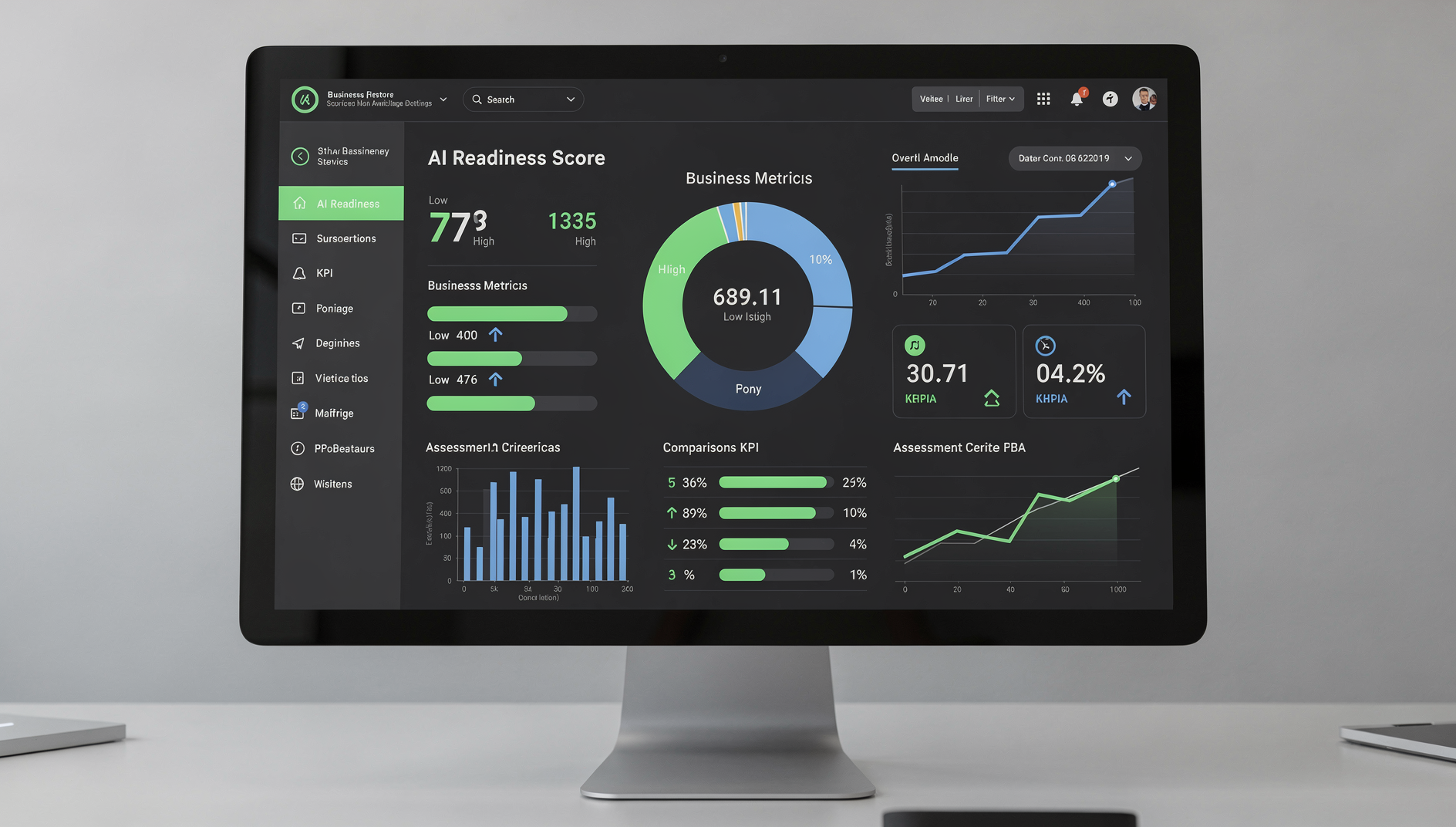
Our AI Readiness Review is a compressed version of the first two stages. It asks six questions, takes about three minutes and returns an instant, industry-specific report naming the two or three highest-impact AI workflows for a business like yours and an estimate of hours saved per week. I then follow up personally within 24 hours to talk through whether any of it is worth building.
Do I need an AI consultant?
You probably need one when a repeatable job eats hours every week, nobody in-house can redesign it, and free tools have not fixed it.
Plenty of small businesses already use AI without any outside help. The U.S. Chamber of Commerce reported in August 2025 that 58% of small businesses said they use generative AI, up from 40% in 2024 and 23% in 2023. Using a chat assistant is not the same as changing how a job gets done, though, and that gap is where a consultant earns a fee.
Three signs you are in that gap: the same task is still done by hand every week even though everyone has a ChatGPT login; the job involves more than one system, such as your inbox, your CRM and your accounts package; and a mistake in it costs real money, so it needs checks rather than a clever prompt.
If all three apply, the arithmetic is worth doing. Take the hours a week the job consumes, multiply by what that person costs you per hour, and multiply by 48 working weeks. That is the number any proposal should be measured against. More on how that works for smaller firms is on our AI consulting for small business page.
When do you not need an AI consultant?
You do not need one if you only want to learn a chat assistant, have no repeatable process, or already know exactly what to build.
You want your team to get better at ChatGPT or a similar assistant. That is training, not consulting. A good course or a half-day workshop will do more for less money.
Your work has no repeatable pattern. AI is good at jobs that happen the same way many times. A business where every job is genuinely different has less to automate, and a consultant will struggle to find a return.
You already know the workflow and the tool. If you have decided that you want missed calls answered by an AI receptionist on a named platform, you need a builder, not an adviser. An automation agency or a freelancer will get there faster.
The software you already pay for has the feature. Many CRMs, accounts packages and help desks now include AI features. Switch those on and test them before paying anyone to build something separate.
You cannot yet absorb running costs. Most AI workflows carry monthly software and usage fees after the build. If the saving does not clearly cover those, wait.
What is the difference between an AI consultant and an AI automation agency?
A consultant helps you decide what is worth building and why; an automation agency builds a workflow you have already chosen, usually faster and cheaper.
Which you need depends on how certain you already are. If you have fifteen small annoyances and no idea which one is costing you money, choosing is the whole job, and that is consulting. If you know exactly which process you want automated and on which platform, an AI automation agency is the better buy.
The line also runs through team size. In his UK guide to consultants and agencies, Chris Garlick describes a consultant as a solo operator or very small team who scopes, builds and supports the work directly, and an agency as a larger organisation where the work passes between account managers, project managers and developers. He suggests a consultant for single-workflow automation and budgets under £40,000, and an agency for multi-team rollouts, formal procurement and budgets above £60,000.
For most owner-managed businesses the honest answer is a consultant first, for a short and cheap diagnosis, and then whoever is best placed to build. Sometimes that is the same firm.
How do you choose an AI consultant?
Choose one who asks about your processes before tools, names what will exist when finished, prices an outcome, and explains what happens when it breaks.

Six questions sort the good from the bad quickly:
- What will exist in my business when you finish? A good answer names a workflow, the systems it touches and who uses it. “An AI strategy” on its own is not an answer.
- Which tools will you use, and why those? Be wary of anyone who only ever recommends one platform.
- Have you done this for a business like mine? Ask for a specific example and, where possible, a reference you choose from their client list.
- How is it priced? A fixed price for a defined outcome puts the delivery risk on the consultant; open-ended hourly billing puts it on you.
- Who owns what you build? You should own the workflow, the prompts and the data, and be able to move them.
- What happens when it breaks? Tools change their connections without warning. Ask who fixes it, how fast, and at what cost.
Helium42 publishes a longer twelve-point checklist for UK buyers that covers the same ground and more, including a technology-agnostic approach, knowledge transfer, intellectual property and post-project support.
When you want names to compare, we keep country lists that describe each firm from its own website, with no scores: the best AI consulting companies worldwide, and the best AI consultants in the UK, Australia, New Zealand, Canada and Ireland. Clever Merchants is on those lists and marked as the author.
How much does an AI consultant cost?
It ranges from hourly advice to fixed-price workflow builds and varies by country; Clever Merchants prices implementation only after the free AI Readiness Review.
Published market figures give a sense of scale. Iternal’s small-business guide puts advisory at $100 to $300 an hour and fixed-scope quick wins at $2,500 to $10,000. In the UK, Helium42 puts freelance AI practitioners at £400 to £800 a day and boutique specialists at £1,200 to £2,500 a day. Those are other firms’ figures, not ours. Our cost guide has a table by country for the UK, US, Canada, Australia and New Zealand, plus Ireland.
Why there is no single implementation figure from us. An AI receptionist for a six-person plumbing firm and automated quoting for a forty-person contractor are different builds touching different systems. The honest price for each only exists once we know what those systems are, and a figure published before that would be either padded or unrealistic.
What you get free first. The AI Readiness Review is six questions and about three minutes, with an instant report and a personal follow-up from me within 24 hours. No card and no obligation, and if the report shows AI is not worth your money yet, I will say so.
Who it is for. Owner-managed operational businesses of roughly 5 to 50 staff: trades and construction, professional services, ecommerce and retail, manufacturing and distribution, and agencies. Not tech companies and not enterprises.
The exception is our generative engine optimisation work, where the scope is fixed: GEO Standard for Ecommerce is EUR 6,500 and GEO Standard for Service Businesses is EUR 7,500. More on how we price is on the pricing page.
A real example: Shamrock Electrical
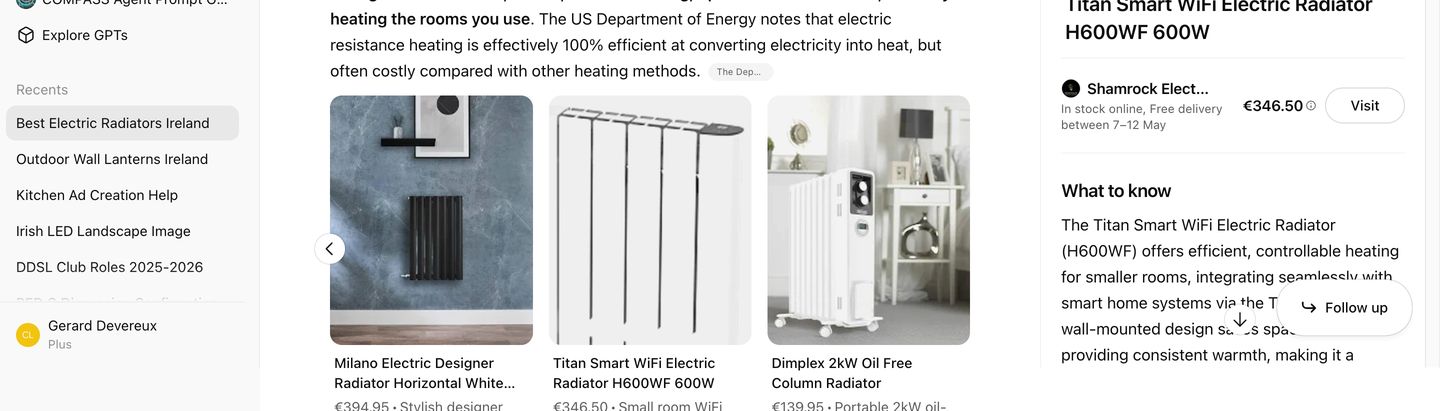
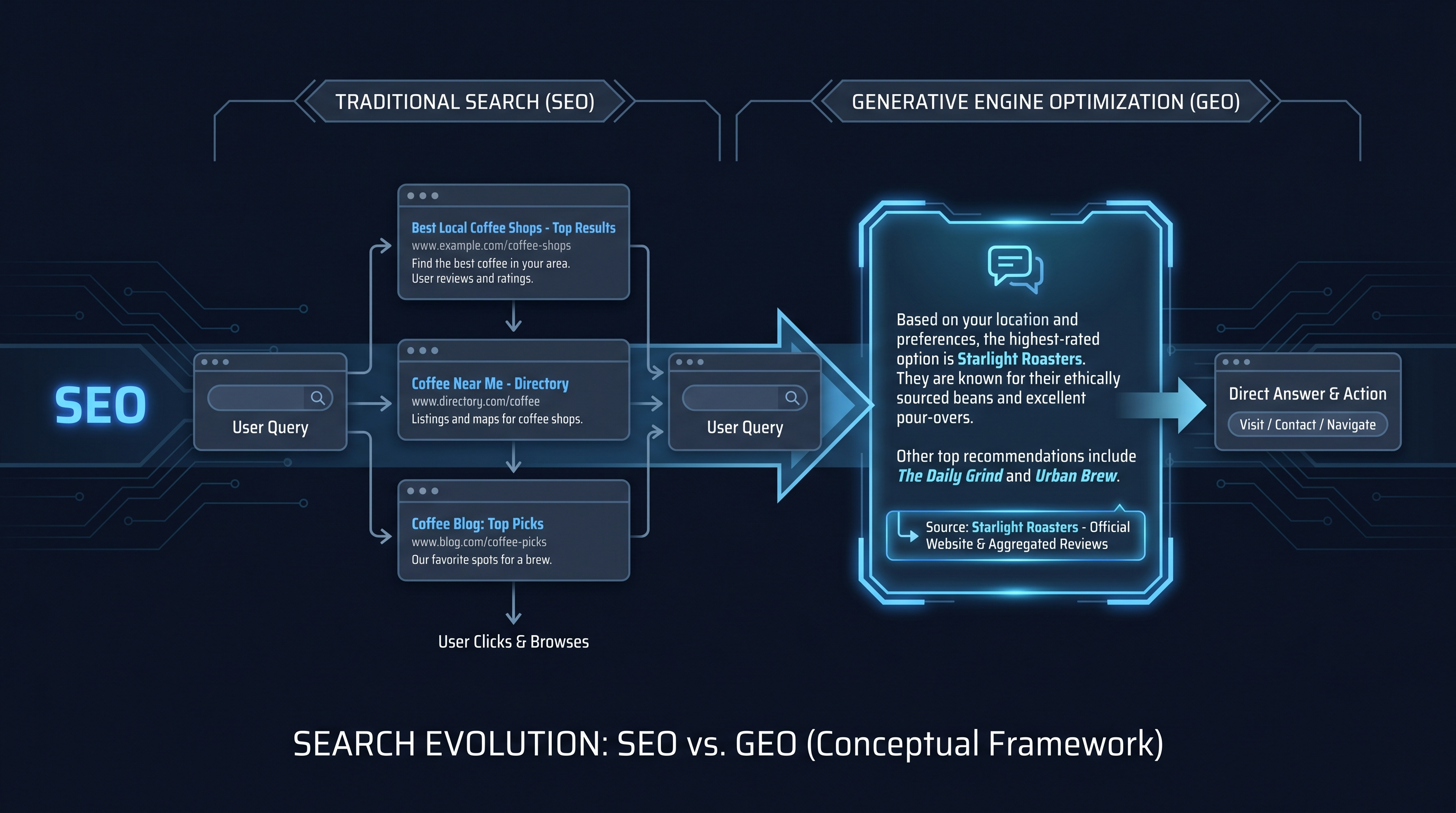
I own Shamrock Electrical, an electrical wholesaler in Rathcoole, Dublin, and it is the live proof of concept for this work. The project was about getting the business recommended by AI assistants rather than automating an internal job, but it followed the same stages as the table above.
The assessment was simple: find out whether AI assistants named the business when asked about the products it sells. The priority was structured data and question-and-answer content, because that was the change most likely to matter and the product data was already clean in Shopify. The implementation was schema and FAQ content on the live store. Seventy-two hours after it went live, ChatGPT cited Shamrock by name, and Perplexity and Gemini later did the same. The full story is in the Shamrock Electrical case study.
The lesson for any AI project is the one in the prioritise stage: the work went quickly because the data underneath was already in order. A business whose information lives in someone’s head pays for the clean-up before it pays for any AI.
What is the 10/20/70 rule for AI?
It is a BCG principle: put about 10% of AI effort into algorithms, 20% into data and technology, and 70% into people and processes.
The figures come from Boston Consulting Group. Its January 2025 report From Potential to Profit: Closing the AI Impact Gap says the companies getting the most from AI dedicate 10% of their efforts to algorithms, 20% to data and technology, and 70% to people, processes and cultural transformation. BCG repeated the same split in What’s Driving AI Value in January 2026.
BCG writes for large companies, but the point holds at 20 staff. Choosing the model is the small part. The big part is changing how the job is done, training the people who do it and making sure they trust the output enough to use it. That is why the train and maintain stages in the table above matter as much as the build, and why a consultant who only talks about tools is doing a tenth of the job. Our guide to the AI readiness assessment for small business covers the people side in more detail.
What is the 30% rule in AI?
There is no single agreed 30% rule. The phrase is used in several ways, mostly about how much work AI should do compared with people.
A June 2026 explainer from BGR calls it “less a hard, defined rule, and more a guideline” and sets out the main uses:
- In the workplace, it usually means AI handles around 70% of tasks, the repetitive and data-heavy ones, while people keep the 30% that needs judgement: quality control, leadership, ethical decisions and creative or critical thinking.
- In education, it is used as a ceiling on how much of a submitted piece of work may be AI-generated. BGR notes that this grew up around AI-detection tools such as Turnitin, which does not itself set that standard.
- In company budgets, it sometimes means putting around 30% of AI resources into data quality, governance and risk.
The nearest thing to a research figure is from the McKinsey Global Institute. Its July 2023 report Generative AI and the future of work in America estimated that activities accounting for up to 30 percent of hours worked across the US economy could be automated by 2030. That is a midpoint of a very wide range, 3.7 to 55.3 percent, and it describes the whole economy rather than any one business.
For an owner, the practical reading of every version is the same: expect AI to take over part of a job, usually the repetitive part, and keep a person responsible for checking the output and making the decisions.
Which AI agent is best for a small business?
No agent is best for every business. The best one does a specific, repeated job inside your existing tools, with a person approving important actions.
An AI agent is software that carries out a multi-step task rather than just answering a question. There are two broad kinds.
General assistants with agent features. When OpenAI launched ChatGPT agent in July 2025, it described ChatGPT completing tasks with its own virtual computer and asking permission before actions of consequence. OpenAI now marks that launch post as outdated and points businesses to workspace agents, which it lists as a research preview for ChatGPT Business, Enterprise, Edu and Teachers plans, and which can run on a schedule for jobs such as reviewing leads, summarising support requests or generating reports.
Agents built for one job. An AI receptionist for a small business that answers and qualifies calls is the clearest example. It does one thing, all day, and is judged on one number: how many enquiries it catches that would otherwise have gone to voicemail.
I would be wary of any list that names a single winner, because the right answer depends on the job. Pick the agent the way you would pick an employee for a role: name the job, count the hours it takes now, check that the agent connects to the systems that job uses, check who approves its actions, and trial it on real work before you commit.
Frequently asked questions
Can an AI consultant work with my business remotely?
Yes, much of the work happens on video calls and inside your existing software, so access matters more than location. Clever Merchants works remotely from Dublin with businesses in Ireland, the UK, the US, Canada, Australia and New Zealand: the review is online, calls are by video and implementation happens inside the tools you already use.
How long does an AI consulting project take?
Published guides put a focused first project in weeks rather than months: Happy Webs in the UK quotes one to three weeks for a single-process automation, and ChatGPT.ca says most Canadian SME projects are two to four week fixed-price engagements. Larger programmes that touch several systems take longer, and the timeline should be written into the proposal before you sign.
What should I prepare before talking to an AI consultant?
Write down the three jobs that take the most repeated hours each week, who does them and which software they use. That list turns a vague first call into a specific one, and it covers much of what the free AI Readiness Review asks in about three minutes.
Will an AI consultant need access to my business data?
For implementation, usually yes, because a workflow has to read from and write to the systems where your work lives. Before you start, ask where your data will be stored, which AI providers will process it and who can switch the workflow off.
Do AI consultants make good money?
In the UK, IT Jobs Watch recorded a median contract rate of £575 a day for AI consultant roles in the six months to 13 September 2026, with the 10th to 90th percentile running from £463 to £734. A day rate is only earned on days that are booked, so it is not the same as an annual salary.
Where to start
The quickest way to find out whether you need an AI consultant is to find out what AI could save your business first. The free AI Readiness Review takes about three minutes, names the two or three workflows worth building for a business like yours, and I follow up personally within 24 hours. If the answer is “not yet”, you will have lost nothing, and you can take the report to any consultant you like.