
TL;DR
- Most agencies now claiming to offer GEO have never actually produced a verifiable citation
- A credible generative engine optimization agency will show you real citations, explain their methodology step by step, and back the work with a guarantee
- Five things to look for: proven citations, a transparent method, defined deliverables, a guarantee, and relevant sector experience
- The right agency will tell you exactly what they are going to do, and let you verify the result yourself
Every agency is suddenly offering generative engine optimisation. SEO shops, web design firms, content agencies, all of them have added GEO to their service list in the past twelve months. Most of them have never produced a single verified citation.
This matters if you are a business owner evaluating who to trust with your AI visibility. The terminology is new, the category is unregulated, and the barrier to claiming expertise is close to zero. Knowing what separates a real generative engine optimization agency from one that has adopted the language without the substance is the first step to not wasting your budget.
Here is what to look for.
What is the best agency for generative engine optimization?
There is no single best one. The right GEO agency shows a citation it produced, explains its method and guarantees a defined outcome.
I am not aware of any independent benchmark that compares GEO agencies on results, so any list that ranks them deserves a careful read. That is why this post names no best agency. The honest answer is a set of tests you can run yourself before signing anything, set out in the five sections below: a named citation you can reproduce, a method explained step by step, a written list of deliverables, a guarantee tied to citations within a fixed time, and experience with businesses like yours.
A disclosure, since you are reading this on an agency’s website: Clever Merchants is a generative engine optimisation agency, and I, Ger Devereux, wrote this post. Our own programmes appear further down so you can hold them to the same five tests, and if they do not pass for your business, choose someone who does. If you want a baseline before speaking to any agency, the free AI Visibility Check shows whether ChatGPT, Perplexity and Google AI cite your business today.
The bandwagon problem
Generative engine optimisation became a category that buyers were searching for in 2024. Within months, “GEO services” appeared on the websites of agencies that had been doing traditional SEO, PPC, or content marketing with no change to their actual methodology.
This is not unusual. It happened with SEO in the early 2000s, with social media marketing in the 2010s, and with content marketing around 2015. Every time a new category emerges, practitioners from adjacent disciplines rebrand.
The difference with GEO is that the verification is unusually straightforward. Either your business appears in ChatGPT’s answer to a buyer query or it does not. Either Perplexity cites you or it does not. There is no ambiguity. An agency that cannot show you before-and-after citations has not done the work, regardless of what their service page says.
What a real GEO agency actually does
Before covering what to look for, it helps to understand what a credible generative engine optimisation agency actually delivers.
AI citation is not a single action. It is the result of several layers of work done in sequence:
Structured data. Schema markup tells AI crawlers what your business is, what it does, who it serves, and where it operates. Without it, AI systems have to infer from unstructured text, and they often infer wrong or not at all.
Question-answering content. AI systems cite businesses whose content answers buyer questions directly. FAQ pages, buying guides, and structured service descriptions give AI tools something to pull from and attribute to you.
Entity recognition. Your business needs to exist consistently across multiple credible sources, directories, review platforms, trade bodies, so that AI systems can confirm you are a real, established business rather than a single website they may or may not trust.
Google Business Profile. GBP data feeds directly into Google AI Overviews and Gemini. Categories, descriptions, services, and the Q&A section all contribute to citation probability.
A real generative engine optimization agency delivers all four layers. An agency doing only content, only schema, or only citation building is doing partial work that may or may not move the needle.
Five things to look for
1. Verified citations they have produced
The most important question to ask any GEO agency is: “Can you show me a citation you produced for a client?”
Not a screenshot of ChatGPT mentioning a category. Not a case study with anonymised results. A specific business, named, being recommended by a named AI tool for a specific query, and the ability to reproduce it yourself by asking the same question.
This is a high bar, but it is the right bar. Citation is the deliverable. If an agency cannot demonstrate it in their own work or for a prior client, they are selling a hypothesis.
At Clever Merchants, the proof point is Shamrock Electrical. The citation is real, named, and reproducible. “Shamrock is the obvious one” is what ChatGPT returned for a buyer query about Irish electrical suppliers after the implementation, and by June 2026 Shamrock was first of five retailers in ChatGPT, up from 1 of 10 buyer questions in April. That is the kind of evidence you should be looking for.
2. A methodology they can explain step by step
Ask the agency to walk you through exactly what they will do.
A credible generative engine optimisation agency will be able to describe the specific technical steps, schema markup types, content formats, citation building targets, GBP changes, without vague language about “AI optimisation strategies” or “proprietary processes.”
Proprietary processes are a red flag in GEO. The underlying mechanisms of AI citation are not secret. They are documented, repeatable, and based on how AI systems are trained to identify and recommend businesses. An agency that cannot or will not explain the method has likely not developed one.

3. Defined deliverables, not vague promises
Before signing anything, you should know precisely what you will receive.
That means: which schema types will be implemented, on which pages, and in what format. Which content assets will be produced. How many citation listings will be built, in which directories, and verified how. What changes will be made to Google Business Profile.
“We will improve your AI visibility” is not a deliverable. A list of specific technical and content outputs with agreed timelines is.
4. A guarantee tied to the actual outcome
The only meaningful guarantee in GEO is a citation guarantee, a commitment that your business will be cited by a named AI tool for a named category of queries within a defined timeframe.
An agency that offers a money-back guarantee if rankings do not improve, or a promise to “continue working until results are achieved” without a time limit, is not offering a citation guarantee. They are offering unlimited labour as a substitute for confidence in the outcome.
At Clever Merchants, both programmes include a 90-day citation guarantee. We track 30 buyer prompts for your business, and if fewer than 3 that did not name it at the baseline do so 90 days after completion, we do one further round of work, up to 21 working days, at no additional cost.
5. Experience with businesses like yours
GEO for a Shopify ecommerce store requires different implementation from GEO for a professional services firm. Product schema, collection-level FAQ content, and structured buying guides are the priority for ecommerce. Service schema, case study content, and local entity building are the priority for B2B service businesses.
An agency that offers one undifferentiated GEO programme for every type of business may not have the depth of experience to handle the differences. Ask specifically whether they have produced citations for businesses in your category.
Red flags to watch for

Vague before-and-after metrics. “Increased AI visibility by 40%” without explaining what that means or how it was measured is not evidence. Ask what specific tool, what specific query, and what specific result.
GEO bundled into an ongoing retainer with no defined end state. Real GEO implementation is largely a one-time exercise. The schema either exists or it does not. The content either answers buyer questions or it does not. An agency selling an open-ended monthly retainer for GEO is often selling SEO under a different name.
No mention of schema markup. Structured data is the single highest-leverage technical change in GEO. If an agency’s GEO service description does not mention schema markup, FAQPage schema, or structured data, they are not doing the core technical work.
Generic content production without citation testing. Some agencies will produce blog posts and call it GEO. Content is one layer of GEO, it is not the whole thing. Without schema, NAP consistency, and a citation footprint, content alone rarely produces citations.
Citations they cannot reproduce. If a case study shows a ChatGPT citation but the agency cannot tell you what query produced it or whether it still holds, the citation may have been cherry-picked or may no longer exist. AI citations can fade if the underlying signals are not maintained.
Questions to ask before you hire
These five questions will tell you quickly whether you are talking to a credible generative engine optimization agency:
-
Can you show me a citation you produced? Ideally for a business similar to mine. Ask for the specific query that returns it and verify it yourself.
-
What schema types will you implement, and on which pages? The answer should include Organization, Service or Product, FAQPage, and LocalBusiness where relevant.
-
How will you build the citation footprint? Ask for a list of specific directory types and how they ensure NAP consistency across all listings.
-
What does the guarantee cover? Confirm it is a citation guarantee, your business named by a specific AI tool for queries in your category, not a vague satisfaction promise.
-
What do I need to do on my end? Real GEO requires access to your website (to implement schema), your Google Business Profile, and ideally input on the buyer questions your customers actually ask. If an agency says they need nothing from you, they are probably doing minimal work.
What this looks like in practice
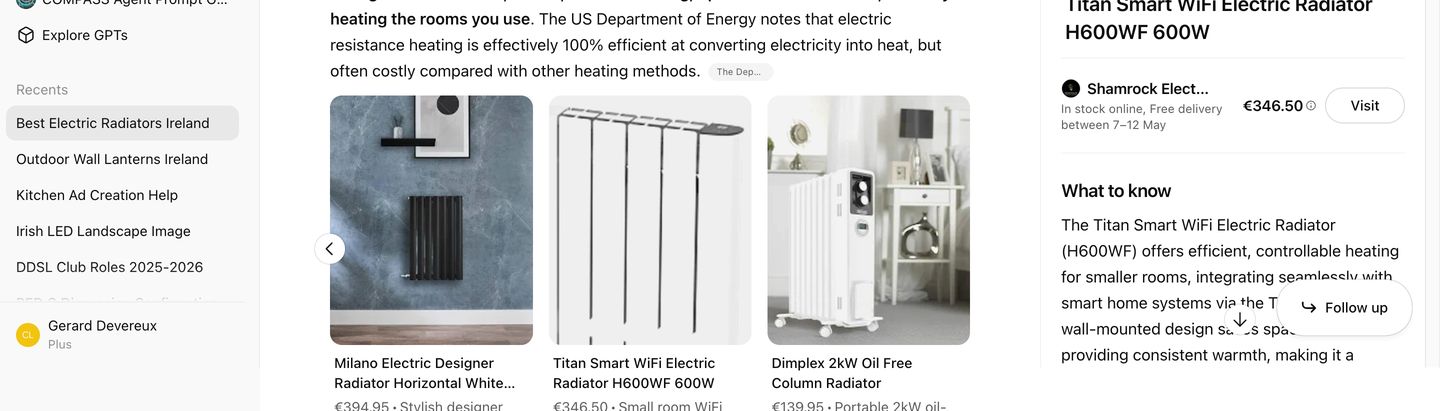
The citation above is from a buyer query about Irish electrical suppliers. The business named, Shamrock Electrical, went from being named in 1 of 10 buyer questions in April 2026 to being described by ChatGPT as “the obvious one” after a single round of GEO implementation, and was first of five retailers in ChatGPT by June.
The method that produced it covers schema markup, FAQ content, GBP optimisation, and citation footprint building. That same method is the foundation of both Clever Merchants programmes. It is documented, repeatable, and comes with a 90-day citation guarantee.
If you want to know where your business stands before committing to anything, the free AI Visibility Check is the right starting point. Ger reviews your answers, checks how ChatGPT, Perplexity and Google AI Overviews describe your business, and follows up personally the same working day.
If you are ready to look at the programmes themselves, GEO Standard for Ecommerce is built for Shopify and ecommerce stores. GEO Standard for Service Businesses covers B2B firms and professional services.
Frequently asked questions
Is GEO the same as SEO? No. Traditional SEO optimises for Google’s ranking algorithm, backlinks, page authority, keyword density. GEO optimises for the signals AI systems use to identify and cite businesses: structured data, question-answering content, consistent entity recognition across third-party sources, and citation footprint. There is overlap, both benefit from clear content and technical hygiene, but they require different implementation.
How long does GEO take to produce results? Faster than traditional SEO. Schema and content changes are indexed by AI systems continuously. Shamrock Electrical went from 1 of 10 buyer questions in April 2026 to first of five retailers in ChatGPT by June. A realistic expectation for most businesses is 4 to 8 weeks from completing the implementation to seeing consistent citations.
Can I do GEO myself? Yes. The technical steps, schema markup, FAQ content, GBP optimisation, citation building, are all learnable. The guide How to Get Your Business Cited by ChatGPT covers the full process. The value of a specialist agency is speed, accuracy, and the guarantee. A business doing GEO for the first time will likely make implementation errors that delay results.
Do I need ongoing GEO work after the initial implementation? The initial implementation is the majority of the work. Once schema, content, and citation footprint are in place, citations tend to hold without significant maintenance. Ongoing work is valuable if your product catalogue or service offering changes materially, or if you want to expand citation coverage into new query categories.
What is the difference between GEO for ecommerce and GEO for service businesses? Ecommerce GEO focuses on product schema, collection-level FAQ content, and structured buying guides, the formats that AI systems use to recommend specific products and suppliers. Service business GEO focuses on Service schema, case study content, local entity building, and Google Business Profile, the signals that produce citations for professional and trade services. The underlying methodology is the same; the content formats and schema types differ.
What if my business already has good Google rankings? Good Google rankings do not translate automatically to AI citations. The two systems use different signals. Businesses with strong traditional SEO are often invisible in AI-generated answers because they have not built the specific structured data and citation footprint that AI systems rely on. GEO and traditional SEO are complementary, the work does not conflict.