TL;DR
- Shoppers increasingly ask AI assistants which products to buy — and most ecommerce stores don’t appear in those answers
- AI product recommendations are driven by schema markup, review signals, content quality, and brand authority
- Ecommerce stores with good traditional SEO often still have major AI visibility gaps
- The fix is structural and implementable within a standard GEO for Ecommerce programme
- Check your store’s AI visibility for free: 2 minutes, no sign-up
How do I get my products recommended in AI shopping results?
Give every product complete structured data, a feed with identifiers and stock, descriptions that answer buyer questions, and reviews and third-party mentions AI can verify.
AI shopping results, whether the product cards inside Google’s AI Overviews and AI Mode, ChatGPT’s shopping answers or Perplexity’s product comparisons, are assembled from product data the engine can check against more than one source. Your product page with Product schema is one source. A product feed with identifiers, price and availability is a second. Reviews, comparison articles and retailer listings that name the same product are the third. A product that exists in all three, with the same facts in each, is one the engine can recommend without risk of being wrong. A product that exists only as a thin page on your own domain is not.
The first-hand example is my own store. Shamrock Electrical, the electrical wholesaler I run in Rathcoole, was named by ChatGPT for an electric radiator query 72 hours after Product and FAQPage schema and buying-guide FAQ content went live. It happened that fast because the underlying data in Shopify was already clean: brand, price, stock and specifications were all present and consistent. The schema and the FAQ content gave the engine a reason to trust what was already there. The full account is in the Shamrock Electrical case study.
The rest of this post covers the four gaps that keep stores out of AI shopping results, the product feed fields that matter, how to track whether you are being mentioned, and what a GEO for Ecommerce programme does about it. If you want the answer for your own store first, the free AI Visibility Check runs your product queries through ChatGPT, Perplexity and Google AI and reports back within 24 hours.
How do I optimize my product feed for AI shopping?
Fill every feed field the engine can check, including GTIN or MPN, brand, price, availability, category, variants, shipping and returns, and match them exactly to your product pages.
Google’s shopping surfaces, including the product results shown inside AI Overviews and AI Mode, are built on the same Merchant Center product data as Shopping ads, and OpenAI now accepts merchant product feeds for ChatGPT’s shopping results. In both cases the feed is the engine’s primary record of what you sell, what it costs and whether it is in stock, and the product page is what it checks the feed against. Where the two disagree, on price, availability or title, the engine has a reason to leave you out.
The fields below are the ones that decide whether a product can be matched, filtered and recommended. Most Shopify and WooCommerce stores populate half of them.
| Product data field | Why AI shopping needs it | Where to fix it |
|---|---|---|
| GTIN, MPN and brand | Lets the engine match your listing to the same product on other sites and pull in their reviews and comparisons | Barcode and vendor fields in your product admin; gtin and brand in the feed and in Product schema |
| Price and availability | AI shopping answers drop out-of-stock items and quote live prices; stale values get the product skipped | Inventory sync; price and availability in the feed; offers in Product schema |
| Product title | The engine matches the title to the buyer’s phrasing: brand, product type, key attribute, size | Product title in your admin and title in the feed, written the way a buyer would ask |
| Description | Answers who the product is for, what it does and what it is compatible with, which is what the buyer asked | Product page body and description in the feed; replace generic copy with specifics |
| Category and product type | Places the product in the right comparison set | google_product_category and product_type in the feed; product type in your admin |
| Variants (size, colour, pack) | Buyers ask for specifics (“in white”, “3-pack”); unvarianted listings miss those queries | Variant setup in your admin; item_group_id in the feed |
| Images | Product cards in AI shopping are visual; missing or mismatched images drop the card | Product images in your admin; image_link in the feed |
| Shipping, delivery time and returns | Buyers ask “can I have it by Friday” and “can I send it back”; engines quote policies they can read | Shipping and returns pages; Merchant Center shipping settings; MerchantReturnPolicy schema |
| Reviews and rating | The engine verifies quality from the aggregate rating and the review text | Review app that outputs aggregateRating schema; product reviews feed to Google |
| FAQ on product and collection pages | Gives the engine a quotable answer to the buyer’s exact question | FAQ section on each page with FAQPage schema |
Fix the feed and the page together. A perfect feed pointing at a page with a different price is worse than no feed, because it is a verifiable inconsistency.
How do I track whether ChatGPT or Perplexity mention my products?
Run a fixed set of buyer prompts in each engine every month and log the results, then use the free AI reports in Bing Webmaster Tools and Search Console.
There is no complete tracker for this, paid or free, and anyone who tells you otherwise is selling one. The engines personalise answers, rotate sources and do not publish citation data for ChatGPT or Perplexity. What works is a manual prompt set: write 15 to 20 prompts in the words your buyers use (“best electric radiator for a conservatory”, “where to buy X in Ireland”, “X vs Y”), run the same prompts in ChatGPT, Perplexity and Google AI Mode on the same day each month, and log the engine, the date, every brand named, whether yours appeared and which URL was cited. After three months you have a trend nobody can sell you.
Two free reports add scale. Bing Webmaster Tools has an AI Performance report showing how often your pages are cited in Copilot answers and for which grounding queries; it is how we know our own guide to getting cited by ChatGPT was cited 482 times in the week of 25 to 31 August 2026. Google Search Console’s Performance report has a Generative AI features filter showing impressions from AI Overviews and AI Mode; ours showed 83 across 12 pages in the same month. Neither covers ChatGPT or Perplexity directly, which is why the prompt set stays the primary record.
If you would rather have the first run done for you, the free AI Visibility Check runs your product queries through ChatGPT, Perplexity and Google AI and sends you a personalised report within 24 hours.
The New Way People Shop Online
Something significant has changed in ecommerce discovery.
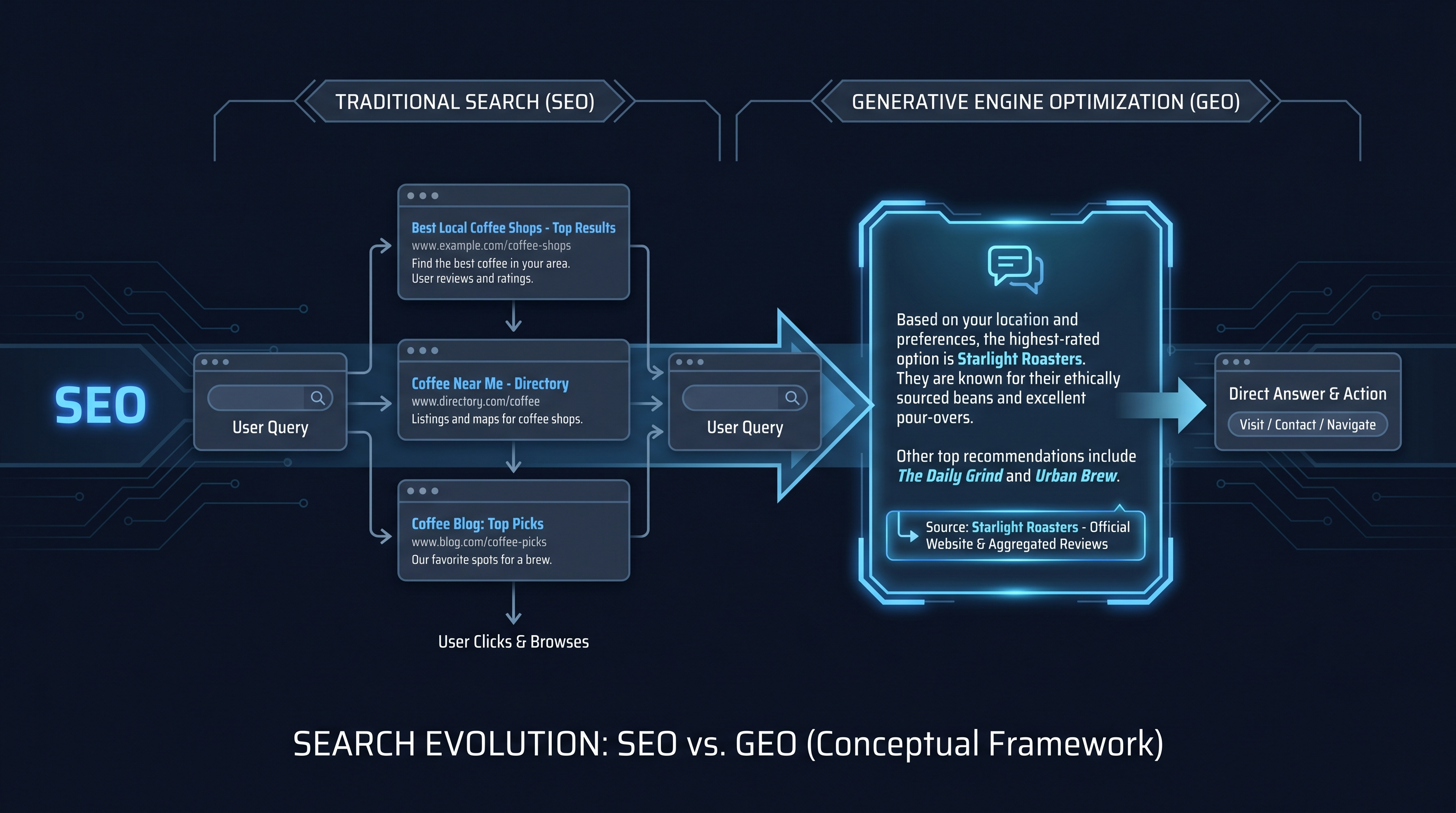
Increasingly, buyers don’t start with a Google search. They open ChatGPT and ask: “What’s the best [product type] for [use case]?” or “Which brand of [product] is worth buying?” or “Compare [Brand A] and [Brand B] for me.”
The AI answers. It names products. It names brands. It gives reasons. And the buyer goes to buy what was recommended.
If your store appears in that answer, you get a high-intent visitor who’s already been sold on your product by the AI. If you don’t appear, that customer has already been pointed to a competitor — before they ever reached a search results page.
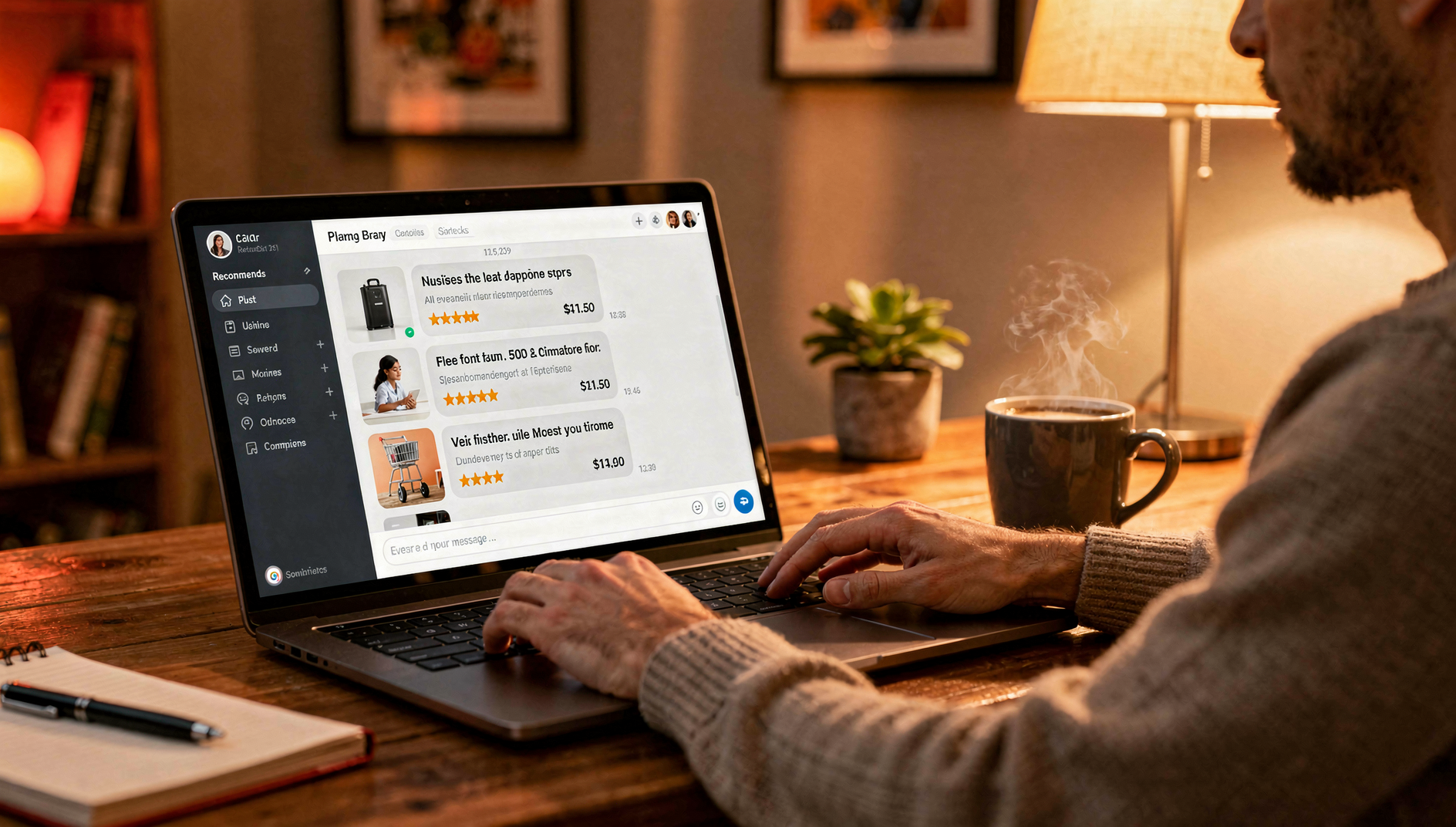
This isn’t a future trend. It’s happening now, and the gap between ecommerce stores that are AI-visible and those that aren’t is already widening.
Why Your Products Aren’t Appearing in AI Recommendations
The most common question we hear from ecommerce store owners is: “We rank well on Google — why aren’t we appearing in AI results?”
The honest answer: Google rankings and AI citations are driven by different signals, and optimising for one doesn’t automatically optimise for the other.
Here’s what’s typically missing:
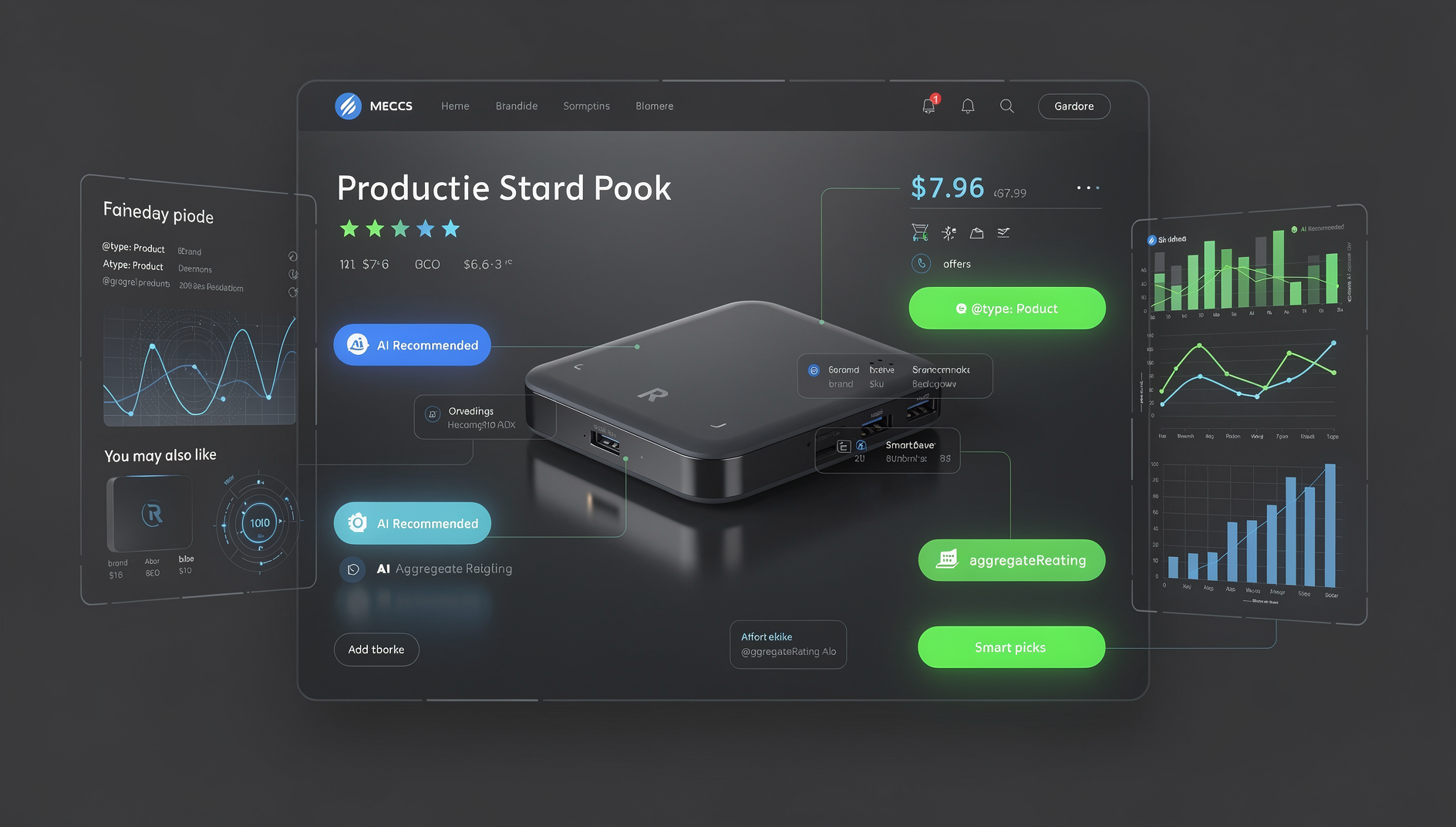
No product schema markup — AI systems understand products much more clearly when they’re described in structured data: product name, description, price, availability, brand, reviews, and specifications all encoded in JSON-LD schema. Most Shopify and WooCommerce stores ship with basic schema but lack the specificity that drives AI citations.
Thin product descriptions — “Premium quality, fast shipping, great value” tells an AI nothing useful. AI systems cite products when the description answers real buyer questions: what it’s made of, who it’s for, how it compares to alternatives, what problems it solves. Thin content is the single most common reason ecommerce products don’t appear in AI recommendations.
Review signals not amplified — AI systems learn from review content. Stores with detailed, keyword-rich reviews (not just star ratings) build a stronger AI citation signal. Most stores don’t have a strategy for generating the kind of review content that influences AI.
No brand authority content — AI recommends brands it has learned about from multiple sources: press mentions, industry directories, comparison sites, affiliate content, and branded searches. A store that exists only on its own domain is harder for AI to treat as an authoritative recommendation.
The Structural Fixes That Drive Ecommerce AI Citations
Getting your products into AI recommendations isn’t about tricks. It’s about giving AI systems the structured, credible information they need to cite you with confidence.
Product schema — beyond the basics
The Product schema type is table stakes. What moves the needle is implementing the full specification: brand, manufacturer, material, audience, additionalProperty for specifications, aggregateRating with review count and score, and offers with current pricing and availability.
For category pages, ItemList schema signals to AI that your store is an authoritative source for that product category — not just a single-product listing.
FAQ content on product and category pages
AI systems are question-answering machines. They cite sources that answer questions well. Every major product and category page should have an FAQ section addressing the questions buyers actually ask: “Is this suitable for X?”, “How does this compare to [competitor product]?”, “What’s the returns policy?”, “How long does delivery take to [region]?”
These aren’t just good for AI citations. They reduce pre-purchase friction and improve conversion rates.
Brand authority signals
Getting your brand mentioned on third-party sites — comparison portals, industry blogs, gift guides, press coverage — is disproportionately valuable for AI visibility. A single mention in a well-regarded publication does more for your AI citation rate than dozens of social media posts.
For ecommerce, this means actively seeking out product reviews from bloggers and influencers in your niche, getting listed on comparison sites, and participating in industry conversations where your products are relevant.

The AI Visibility Gap: What Your Competitors Already Know
Many ecommerce brands are already investing in AI search optimization — and the ones that move first in their niche tend to hold that position.
The mechanism is straightforward: AI systems learn associations over time. A brand that appears consistently in AI recommendations for a product category builds a stronger association with that category. Later entrants have to overcome that learned association, which takes longer.
The competitive window is narrowest for niches where one or two brands are already AI-visible and others aren’t. In those niches, the time to act is now.
For niches where no brand has established clear AI visibility yet — often the case in more specialised product categories — the opportunity is open.
The free AI Visibility Check will tell you exactly where your store stands relative to the signals AI systems use to recommend products.
What a GEO Programme Delivers for Ecommerce
A full GEO for Ecommerce programme typically runs over 21 working days and covers:
Week 1 — Audit and structural fixes: Schema markup implementation across product and category pages, NAP consistency check, review signal audit.
Week 2 — Content and FAQ layer: FAQ sections added to high-priority pages, product descriptions expanded to answer buyer questions, comparison content created for highest-volume categories.
Week 3 — Authority signals: Brand mention strategy implemented, priority directory submissions, review generation process set up.
At the end of the programme, you receive a verification report showing citations achieved across ChatGPT, Perplexity, and Google AI Overviews — with screenshots. And if you’re not being cited within 90 days of implementation completing, we keep working at no additional cost.
Frequently Asked Questions
Does this work for Shopify stores specifically?
Yes. Shopify’s default schema is functional but limited. A GEO programme adds the additional schema fields that drive AI citations — including full product specifications, FAQ schema on collection pages, and brand-level structured data. All of this is implemented without modifying your theme files in ways that would break on updates.
My products rank on the first page of Google. Will they automatically appear in AI results?
Not automatically. Google rankings and AI citations are correlated but not equivalent. We regularly work with ecommerce stores that have strong organic Google traffic but near-zero AI visibility — the signals that drive each are different enough that they need to be addressed separately.
How many products do I need before AI search optimization is worth it?
There’s no minimum, but the ROI is highest for stores with at least a defined product range (say, 10+ SKUs) and some existing traffic. For very new stores with no domain authority or review base, building the foundational signals first is usually the right sequence.
Can AI citations drive measurable revenue?
Yes, and it’s measurable. We track the query types that result in citations and cross-reference with traffic and conversion data to estimate the revenue impact. AI-driven traffic tends to convert at a higher rate than broad organic traffic because buyers arrive with a specific product recommendation already in hand.
How do I check whether my products are currently appearing in ChatGPT?
The free AI Visibility Check covers this. You can also test manually: open ChatGPT and ask it to recommend products in your category. Note which brands appear and whether yours is among them. Perplexity is worth testing too — its AI search is particularly influential among high-spending, research-oriented buyers.
Is there a minimum revenue or traffic level for a GEO programme?
Our programmes work best for ecommerce stores doing €500K or more in annual revenue. Below that threshold, the return on a full programme can be harder to justify in the short term. The free AI Visibility Check and a strategy call will give you an honest assessment of where you stand and whether the timing is right.

The buyers are already asking AI which products to buy. The question is whether yours are the products it recommends.
Check your store’s AI visibility, free, with a personalised report within 24 hours. If you already know the gaps and want them closed, GEO for Ecommerce is the fixed-scope programme that does it in 21 working days.